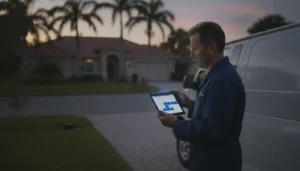
Customer management software is a system that stores your leads, jobs, communications, and reviews in one place so nothing falls through the cracks. For contractors, it replaces sticky notes, spreadsheets, and scattered text threads with one dashboard your whole crew can see. If you’re a roofer, flooring pro, or HVAC company juggling dozens of active jobs, this is the tool that keeps you from losing a $15,000 bid because a follow-up email never got sent.
What Does Customer Management Software Actually Do?
At its core, customer management software — often shortened to CRM, or customer relationship management — tracks every interaction a prospect or client has with your business. That includes the first phone call, the estimate, the signed contract, the job schedule, and the review request after completion.
For home service businesses, the best systems go further than generic office software. They should handle:
- Lead capture from your website, phone calls, and text messages
- Automated follow-ups so a lead who doesn’t answer isn’t forgotten
- Job scheduling tied directly to the customer record
- Review requests sent automatically after the job is marked complete
I spent years selling water filtration systems before building out training systems for contractors, and the pattern never changed: the crews that wrote everything on a whiteboard lost more deals than the ones using a real system — not because they sold worse, but because they followed up worse.

Is Generic CRM Software Enough for Contractors?
Generic CRM platforms built for retail or B2B sales often miss what contractors actually need: job-site photos, material lists, crew scheduling, and one-legger appointment tracking (a one-legger is a sales call where only one decision-maker is present, which affects close rates differently than a two-person household). According to the U.S. Small Business Administration, choosing software that fits your specific operations — rather than forcing your workflow into someone else’s template — is one of the biggest factors in whether small business technology adoption actually sticks.
That’s why we built a customer management platform designed specifically for contractors, rather than recommending a repurposed sales tool. It ties directly into lead engagement so a lead that comes in at 9 p.m. still gets a response before a competitor calls back in the morning.
📊 Data Point: The Federal Trade Commission notes that businesses collecting and storing customer contact data are expected to follow basic data security practices, which is worth confirming with any software vendor before you sign a contract. (ftc.gov)
Does Location Matter When Choosing a System?
Not for the software itself, but for how you use it. A pool company in Orlando fields a different lead flow than a remodeling crew in Jacksonville, and an HVAC comfort advisor in Tampa needs faster response times during summer heat spikes than a chimney company in Ocala does in the off-season. Contractors across Gainesville, Leesburg, and Daytona Beach all tell us the same thing: the system has to match the pace of their local market, not a national average.
🏠 Local Note: We see the biggest jump in close rates among Ocala and Jacksonville contractors once lead response time drops under five minutes — something a connected CRM makes realistic, not aspirational.
What Are the Limits of Customer Management Software?
Software doesn’t close deals by itself. It organizes the information your sales team needs, but a poorly trained rep with great software still loses jobs. We’ve watched contractors buy an expensive platform expecting it to fix a sales process problem, only to find the real gap was in how estimators handled objections. If your team needs that piece, pair the system with actual sales training for contractors rather than treating software as a cure-all.
It’s also worth being honest that migrating years of customer history into a new system takes real time — usually a few weeks, not a weekend — so plan the switch during a slower season if you can.
Quick Checklist Before You Buy
- Does it capture leads from calls, texts, and your website automatically?
- Does it trigger review requests without manual data entry?
- Can your office staff and field crew both access it from a phone?
- Does the vendor explain data security practices clearly?
- Is there training included, or will your team be guessing?
Customer management software won’t replace a strong sales process, but it will stop good leads from quietly disappearing. For contractors in Tampa, Orlando, Jacksonville, and Ocala running multiple crews, that organization is often the difference between a busy season and a profitable one. If you want to see what a contractor-built system looks like in practice, reach out to our team and we’ll walk you through it.