Sales training for contractors teaches the people who quote your jobs how to run one repeatable conversation with a homeowner: diagnose before you price, present options without sounding like a car lot, and handle “let me think about it” without discounting. Legacy Sales Engineering delivers it in your office and on your trucks, in Florida and nationwide, built on Solution Based Questions and a seven-step process.
You already know how to do the work. The furnace gets fixed, the gutters get hung, the floor goes down straight. What most contractors were never shown is what to say between the handshake and the signature, and that gap is where the money leaks out. This guide walks through what real sales training looks like for a trade business, what it changes, what it costs, and how to tell whether you need it before you spend anything.
Why do good contractors lose jobs they should have won?
Because the estimate does the talking. A homeowner asks for a quote, you measure, you send a number, and now the only thing left to compare is price. Three bids, three numbers, and the cheapest one wins unless somebody built trust before the number showed up. Most trades never had a sales conversation taught to them. They learned the craft from a mentor and learned selling by guessing, so the appointment runs on instinct and instinct is inconsistent.
The pattern shows up the same way in every shop. Referrals close because trust arrived early. Cold leads stall because trust never arrived at all. The owner closes at a high rate and the crew closes at a low one, so the owner keeps every appointment and the business stops growing at the width of one calendar. Sales training for contractors exists to fix that specific gap: turning a quote into a conversation and turning one good closer into a process anybody on the truck can run.
What does sales training for contractors actually teach?
It teaches a sequence, not a pitch. The version we run at Legacy Sales Engineering has seven steps, and they happen in an order that homeowners find comfortable rather than pushy. You open by earning a few minutes of real attention. You ask questions before you ever touch a tape measure. You find out what the homeowner is worried about, what they’ve already tried, and who else has to be part of the decision. Only then do you inspect, and only after that do you present.
The questions are the heart of it. We call them Solution Based Questions, and they’re built to surface the real problem instead of the surface complaint. “The AC isn’t cooling” is a symptom. “We’ve had two companies out and both said something different and my wife is done with this” is the actual situation, and it changes what you present and how. Training drills those questions until they come out in your own words, in your trade’s language, without sounding scripted.
The back half of the sequence covers presenting good, better, and best without apologizing for the top option, reading which kind of buyer is sitting across from you and changing pace to match, and what to say out loud when someone needs to think about it. That last one is where most contractors fold. Trained estimators treat it as a question that got missed forty minutes earlier and go back for it.
How is training for a trade different from generic sales training?
Generic sales courses are written for people selling software over Zoom. They assume a long cycle, a procurement department, and a buyer who’s comparing feature lists. None of that is your appointment. You’re in a kitchen at 6:45 on a Tuesday, the homeowner is tired, the dog is barking, and they want to know two things: can you fix it and what will it cost. The whole conversation has to fit inside that reality.
Contractor sales training accounts for the in-home dynamic. It covers how to handle a spouse who wasn’t at the first visit, how to present when the decision maker is on speakerphone, and what changes when the job is an emergency versus a planned upgrade. It also respects the fact that your estimators are technicians first. They didn’t sign up to be salespeople and they’ll reject anything that feels like manipulation. The training has to give them a way to help the homeowner decide, not a way to trick them into it. When it’s built that way, technicians take to it, because it finally gives them a structure for the part of the job nobody ever explained.
Who on the crew should be trained?
Anyone who quotes a job or talks to a homeowner about money. That’s usually the owner, the estimators or comfort advisors, and sometimes a lead tech who does service calls that turn into replacement conversations. If your office staff sets appointments, they’re worth including on the front-end pieces, because the first phone call shapes the whole appointment.
The mistake we see most is training only the new hire and leaving the owner out. The owner is usually the best closer, which means the owner’s habits become the standard, good and bad. When the owner sits in the room, the whole crew ends up speaking the same language, and the owner finally gets what’s in their head out into a sequence they can hand off. That handoff is the entire point. A business where only one person can close is a business with a ceiling.
What does contractor sales training cost, and what’s the return?
We price by engagement, not per seat, and we tell you the number on the first call. There’s no proposal cycle and no per-head licensing. What you’re buying is time in the room with your real jobs and real objections, plus follow-up while the process beds in. Anyone who publishes a flat price without knowing your team size and your current close rate is selling you a course, not training.
The math on return is simple enough to run yourself. Take your monthly estimate count, your current close rate, and your average ticket. A ten-point lift in close rate on 40 estimates a month at a $6,000 average ticket is four more jobs and $24,000 in revenue you were already paying to generate. Most shops we work with are running estimates they’ve already paid for through marketing and leaving a third of them on the table. Training doesn’t add leads. It stops wasting the ones you have, which is why it usually comes before more ad spend, not after.
How do you know if the problem is sales or marketing?
Look at two numbers. If the phone rings and you’re running estimates but not signing them, it’s sales. If the phone is quiet, it’s marketing. If you’re not sure, ask who follows up when a homeowner says they want to think about it, and how many times. Most shops have no answer, which means the money is leaking at follow-up and that’s a process problem, not a lead problem.
We look at both before recommending anything, because pouring more leads into a process that loses them is the most expensive mistake in home service marketing. Sometimes the answer is training. Sometimes it’s lead engagement so nobody waits four hours for a callback. Sometimes the appointments are fine and the phone just needs to ring more, which is local SEO and ads. When you want all of it run as one engine with one person accountable, that’s The Full Stack. The first call is where we tell those apart.
What happens in a training engagement, step by step?
Step one is the evaluation call, about thirty minutes. We ask how many estimates you ran last month, how many turned into jobs, and what happens between the phone ringing and a tech arriving. You leave that call knowing what we’d change first and what it costs. If the honest answer is that you don’t need us yet, you’ll hear that.
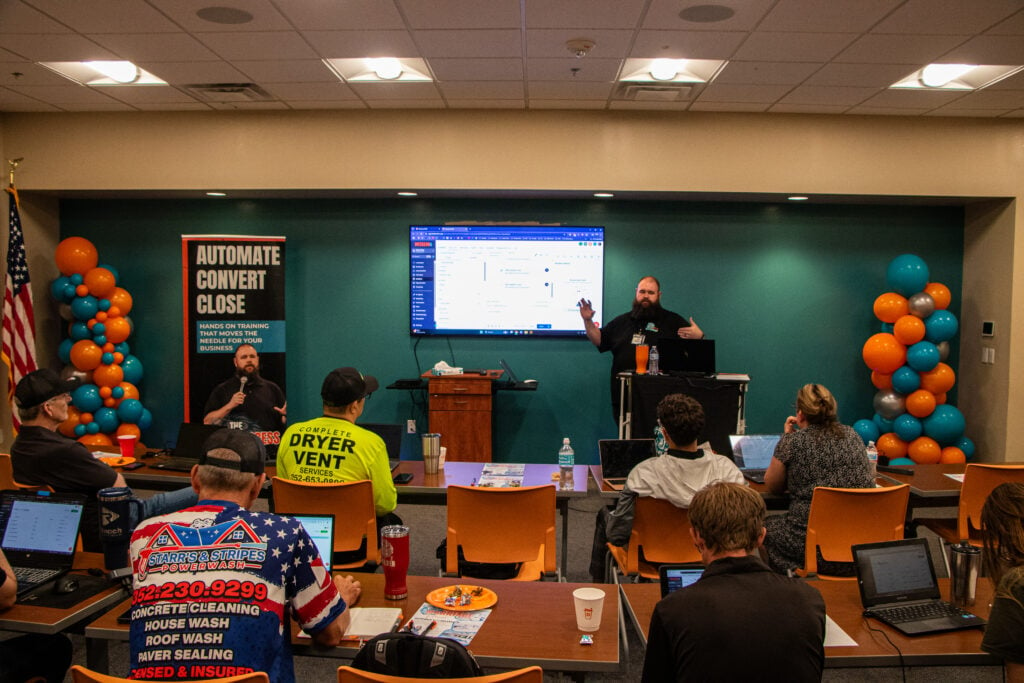
Step two is the training itself, delivered in your office or on your trucks with your real jobs. We work through the seven-step sequence, drill the Solution Based Questions in your trade’s language, and run the objections your estimators actually hear. Nothing is generic. If you sell chimney work, we’re talking about chimney work.
Step three is staying on the tools. A one-day seminar everyone forgets by Thursday is entertainment, not training. We sit in on real calls, review appointments that went sideways, and keep adjusting the process until it holds on a bad day without anyone thinking about it. That’s when it’s yours. For a single owner or estimator who needs the work one on one, private coaching runs the same method with one person in the room.
Questions contractors ask before they book
How long does sales training take to show results?
Close rate usually moves within the first few weeks, because the biggest gains come from questions your estimators simply weren’t asking. Getting the full sequence to run automatically, without anyone thinking about it, takes a couple of months of real appointments and follow-up.
Will my technicians resist being trained to sell?
They resist being trained to manipulate. When the training is built around helping the homeowner make a good decision, which is what Solution Based Questions do, technicians usually take to it faster than career salespeople, because it gives them structure for the part of the job nobody ever explained.
Do you train remotely or only in person?
Both. Hands-on, in-the-room training is concentrated in North Central Florida, and we travel for larger engagements. Remote training works well for follow-up sessions, call reviews, and teams spread across service areas. The first evaluation call is always free and always remote.
What trades do you work with?
HVAC, chimney, flooring, gutters, power washing, and commercial cleaning, plus adjacent home service trades. The sales process is largely the same across them. What changes is the diagnostic language and the typical ticket size, and the training adapts to yours.
Is this the same as a sales script?
No. A script gives your estimator lines to say. A process gives them questions to ask and an order to ask them in, then lets them answer in their own words. Homeowners can hear a script instantly and it costs trust. A process sounds like a person who knows what they’re doing.
Ready to see where your estimates are leaking? Book a free evaluation call. Thirty minutes, no pitch deck. We’ll look at your numbers and tell you plainly whether training is the right first move or whether something else is. Book a call or call (352) 612-3327. Stop selling. Start solving.