
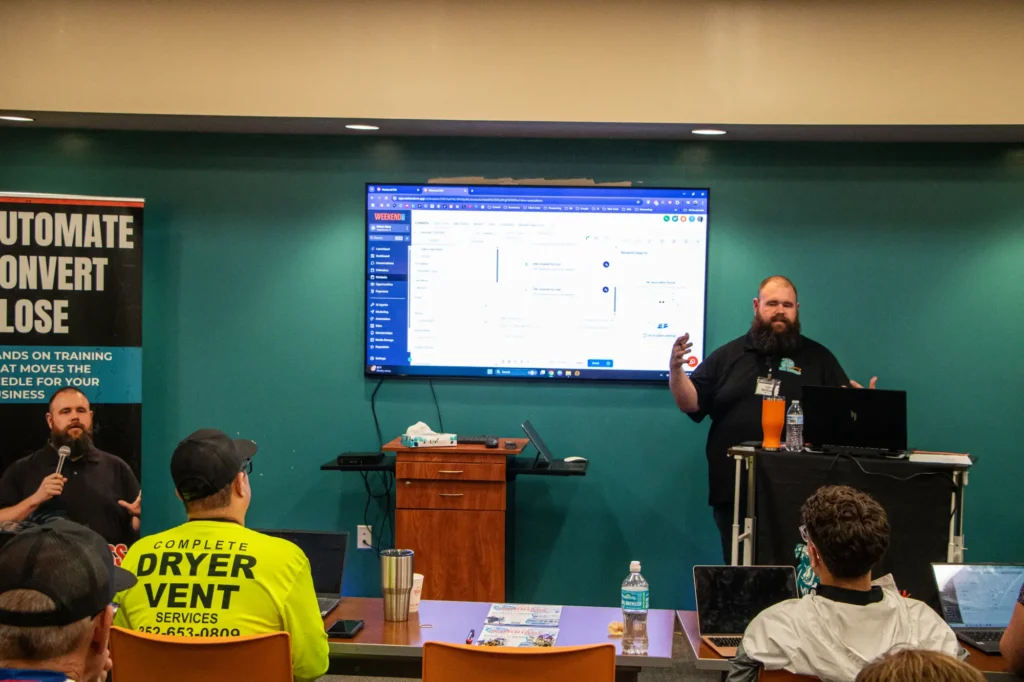
Sales leadership for a contractor means building a process that closes jobs without you in the room. The owner is usually the best closer in the company, which is a compliment and a ceiling in the same sentence. Leadership is the shift from being the person who sells to being the person who builds sellers: a written sequence, a feedback loop, and a CRM that shows where every deal stalls.
Ask most owners who their best closer is and they say their own name. The jobs you sit in front of get signed. The ones you hand off come back at a lower price or don’t come back. So you keep the appointments, keep the truck, keep the evenings, and the company stops growing at exactly the width of your calendar. This article is about the specific skills that move an owner from best closer to sales leader, what changes in the business when that happens, and why most contractors never make the switch even though they know they should.
Why is the owner being the best closer a problem?
Because it caps revenue at the number of appointments one person can run. If you close 60% and your two estimators close 30%, the rational move every week is to take the appointments yourself. And every week you do that, the estimators don’t get better, you don’t get free, and the business learns that selling is something the owner does. That’s not a sales team. That’s a bottleneck with a truck.
The deeper cost is what the owner’s hours would have been worth doing something else. Every appointment you run is an afternoon not spent on hiring, pricing, systems, or the thing that actually grows a contracting business: the process that lets someone who isn’t you deliver what you deliver. A leader’s job is to make themselves unnecessary at the kitchen table. Most owners treat that as a threat instead of the goal.
What does sales leadership actually involve?
Three things, and none of them are charisma. First, a written process. The seven-step sequence, the questions before the price, the answers to the six objections your trade hears. If it lives in your head, you can’t lead anyone to it. Writing it down is the first act of leadership, and most owners have never done it, because they’ve never needed to. It’s obvious to them.
Second, a feedback loop that doesn’t depend on you being present. A CRM that logs outcome, stall point, and buyer type on every appointment tells you where each estimator loses deals without you riding along. A weekly twenty-minute review of those numbers, one rep at a time, does more than a month of ride-alongs. Leaders coach from data. Owners coach from memory, and memory is selective.
Third, the discipline to let a rep lose a job you’d have won. If you step in every time an appointment wobbles, the rep never learns and the homeowner learns to ask for you. Leadership means tolerating a lower close rate for a season so the rate can rise on its own. That’s the part most owners can’t do, and it’s why the ceiling holds.
What’s the difference between managing salespeople and leading them?
Managing is watching the number. Leading is changing it. A manager sees that Mike closed four of fifteen this month and tells him to do better. A leader pulls Mike’s fifteen appointments, sees that eleven died at “let me think about it,” and spends thirty minutes on the questions Mike should have asked forty minutes before that objection showed up. One is a performance review. The other is a fix.
Leading also means the standard is the process, not you. When the standard is “sell like Shawn,” nobody can hit it, because nobody is Shawn. When the standard is “run the seven steps, ask the diagnostic questions, present three options, handle the objection with a question, ask for the job,” anyone can be measured against it and coached toward it. The training we run exists to install that standard so it belongs to the business instead of to the owner.
Turnover data is worth a look here even though most of it comes from software sales, where tenure averages about 18 months and replacement costs run well into six figures. Trades see lower numbers on both, but the mechanism holds: reps leave places where they’re not taught how to win. A leader who builds a process retains the people they trained. An owner who keeps the process in their head trains people for the competitor down the road.
How do you build a sales process the crew will actually follow?
Start with what already works. Take your last twenty signed jobs and your last twenty lost ones and look for the pattern. Where in the conversation did the wins turn? Where did the losses stall? That’s your process, and it’s already been proven, because you ran it. Now write it down in the order it happens, in the language of your trade, and hand it to the crew as “this is how we sell here,” not “this is how I sell.”
Then make it the only way. Every appointment gets logged against the steps. Every debrief asks which step the deal stalled on. Every training session drills one step at a time. When the process is the framework for every conversation about selling, the crew stops seeing it as the owner’s preference and starts seeing it as the job. That’s when it holds without you enforcing it.
Resistance usually comes from the best rep, because they’re already winning without it. Bring them into building it. A rep who helped write the process defends it. A rep who was handed it tolerates it until you stop looking.
What happens to the business when the owner stops selling?
Revenue dips for a quarter and then climbs past where it was, because three people at 45% out-produce one person at 60% by a wide margin. The owner gets time back and, for the first time, uses it on things that compound: hiring the next estimator, tightening the follow-up cadence, fixing the pricing. The crew develops a bench, so when one rep leaves, the business doesn’t lose a third of its close rate overnight.
And the business becomes sellable, or at least hand-off-able. A company where the owner is the only closer has no value to a buyer and no future without the owner. A company with a documented process, a trained crew, and a CRM full of stall-point data is an asset. That’s the legacy version of the business, and it starts with the owner deciding to lead instead of close.
If you’re the owner who still closes everything and you know it’s a ceiling, that’s what one-on-one coaching is built for: getting what’s in your head into a sequence you can hand off. If the whole crew needs the same fix, that’s team training, and it costs less per head.
Questions owners ask about leading a sales team
How do I coach reps when I’m out on jobs all day?
From the CRM, in one weekly block. If every appointment logs outcome, stall point, and buyer type, you can see each rep’s pattern in ten minutes without riding along. Coach the pattern, not the individual call.
My best rep doesn’t want to follow a process. What do I do?
Ask them to help build it. A rep who’s winning has a process, they just haven’t written it down. Get their version on paper, merge it with yours, and they’ll own it. A process handed down gets tolerated. A process co-written gets defended.
Should I stop running appointments entirely?
Not at first. Keep the biggest or most complex ones while the crew ramps, and use them as training runs with a rep in the truck. Over a quarter, hand off more. The goal is that you could stop, not that you must.
How do I know if my sales process is good enough to hand off?
If you can write it down in one page, in order, in your trade’s language, with the five most common objections and the response to each, it’s ready. If it takes you a paragraph to explain what you do in the first five minutes, it isn’t yet.
What’s the first thing to change if I want to lead instead of close?
Write the process down this week. Everything else, the CRM fields, the debriefs, the training, depends on there being something to lead people toward. Most owners skip this step because it feels obvious, and that’s exactly why nobody else in the company can do what they do.
Ready to stop being the ceiling? Book a free evaluation call. We’ll look at how your appointments run and where the process lives, and tell you plainly what it would take to hand it off. Book a call or reach us at (352) 612-3327. Stop selling. Start solving.